Has Backdrop Failed?
Social Apps grow fast or they do not grow at all


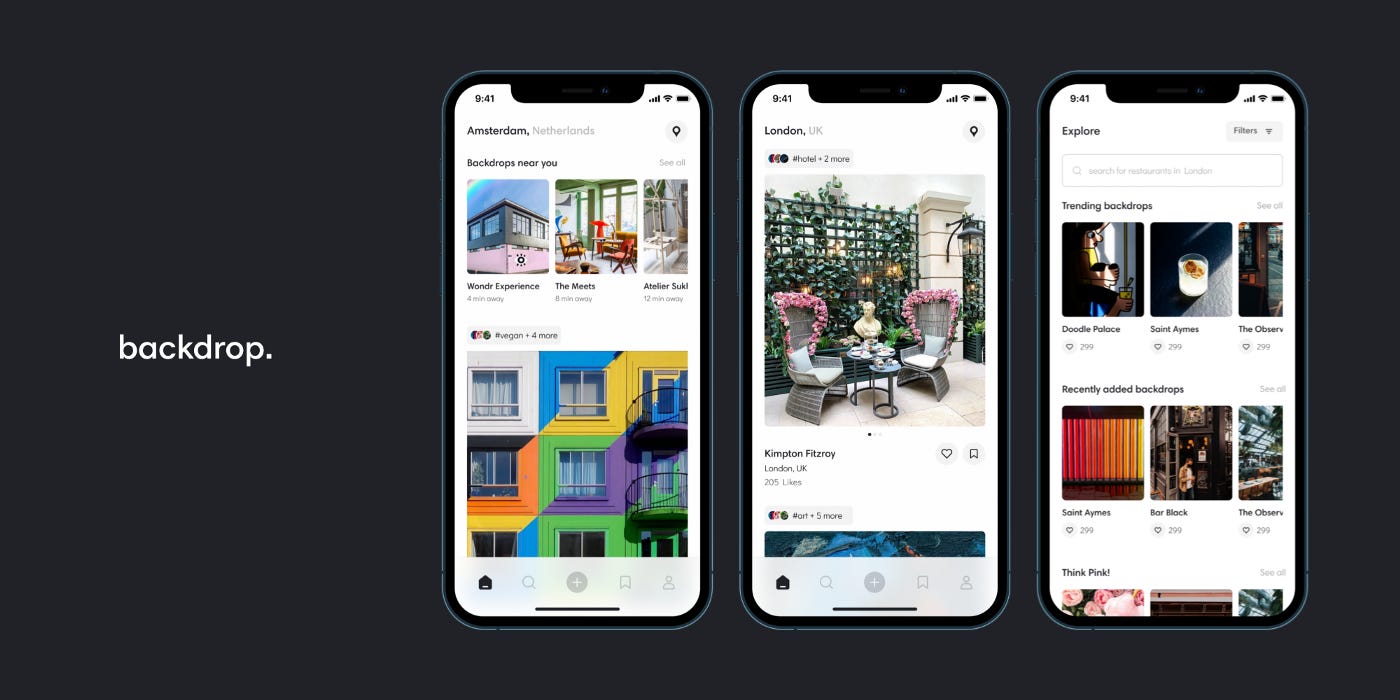
At first — or even second — glance at Backdrop it’s easy to see why many people saw a new dawn for African social products. The launch saw eager-eyed commentators compare them to leading social networks.
A year on from when we first heard about it, Backdrop has not grown hence failing the unspoken rule of social networks - “Socials does not happen over the course of a decade. Social networks form all at once or never”
To see what I mean by the last point, consider some of the points below
Every social media begins with a vertical but succeeds with every vertical
Every social media began with the vertical and targeted a cohort of users with the most need for the product.
TikTok was teens who were lip-syncing and dancing.
Clubhouse was the usual Tech VCs discussing the future.
Instagram was artists and designers, sharing lifestyle photos.
Facebook was college teens who wanted to connect with friends
SnapChat was high school teens who needed a private messaging app
OnlyFans was adult rated users who needed a paywall.
Backdrop aim is to be the go-to travel app for exploring and fundamentally changing the experience of travel. A good vertical to begin with in all cases.
But the founder Timi Ajiboye echoed my thoughts here that every successful social network captures all verticals, the problem is that you can not see a future for Backdrop where they capture all verticals. That in itself is a problem.
“Instagram is like an operating system for pictures. Everything is happening on Instagram — travel, beauty, e-commerce. Same with Pinterest, Increasingly, you’ll find that for some people, they use these platforms for travel and there hasn’t been any experience created for travel that takes into consideration 2021, which is people like to take pictures in front of places that look great and share with their friends.” he said to TechCrunch in an interview.
Give access to everyone, iPhone + Android early on
The most successful social products figured out early that the iPhone only model was unsuitable for success (Clubhouse more recently). You have to enable access to every user in that vertical at once.
The barrier to entry has to be low for everyone, WhatsApp needs a phone with internet, Instagram lowered barrier to posting pictures and TikTok did the same for content creation.
Backdrop made it impossible for users to add pictures, a community model was first which was always going to be unsustainable. Then they made photo creation to pass a verification for quality of photos. This makes it harder for users who do not have photos uploaded to keep on doing it. It is difficult for them and I understand why.
They also did not and have not yet released an android application, stunting their growth even further.
New networks can only survive if their content can travel over existing networks.
The existing primary social network is the place where all new social media apps gain traction. Twitter and Facebook were Instagram's primary social networks. Instagram made its mark on distribution after allowing simultaneous posting to Twitter, Facebook, and Instagram.
This was Instagram and Twitter for Vine. For Musically and TikTok, it was Instagram.
Clubhouse used Twitter for this.
I expected Backdrop’s primary place for distribution to be Pinterest and Instagram, it makes sense because that is the medium you are trying to improve on.
This is the case for teams who try to copy models without understanding the underlying effects.
It's not working if your metrics aren't exploding (even if it looks good).
Social media apps are used to connect with other people or become popular. What good are they if no one is using them? As users steadily increase week after week, they'll churn out before the next cohort arrives, causing network amplifiers to burn out instead of compounding.
The target is like 10M users within 1 year of launch and 50%+ retention.
The founder echoed those thoughts here
“There are many opportunities with discovery and content creation around travel,” Ajiboye said. “What’s very important is that a community has to exist and our early users will shape what the platform is. So right now, growth is the priority and we think there are different ways money can be made.”
Backdrop is older than 1 year today and it is very difficult to see any sign of the growth he spoke of.
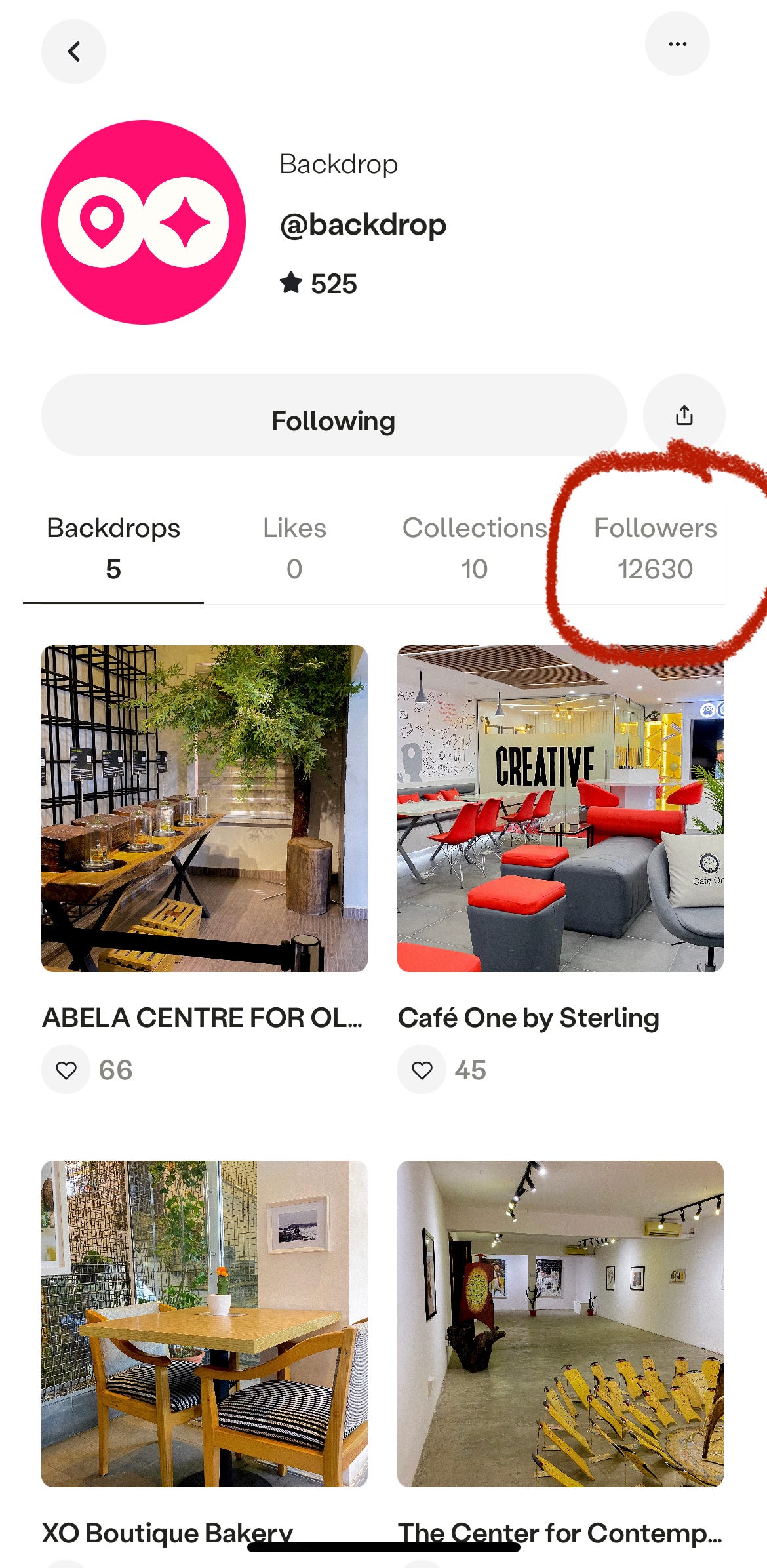
Hint: Every Backdrop user follows the backdrop official account on the app. Currently the user base stands at 12600 users.
Without the growth, you can’t make money, As Mark Zuckerberg frequently explains,
there is a formula for monetization: first grow users, then increase engagement, next attract businesses, and finally sell ads.
Building Existing mediums with a spin will not work
There is only one winner in social media per medium for a very long time.
Twitter will be the last message broadcast text app for a very long time.
Instagram will be the last photo broadcast app.
TikTok will be the last broadcast video app.
iMessage will be the last messaging app on iPhone for a while.
WhatsApp, WeChat are the last messaging apps on android for a long time
The best user experience or the best social hook will not be enough to dethrone these perpetual advantages.
The library, the social graph, the creators' network, and consumer habits are the sources of value.

Final Thoughts
There are some apps that combine multiple mediums into one. People don't care. There will be no excitement for it if it isn't a new medium.
All user-generated content networks enfranchise a class of content creator that was previously disenfranchised
Unless content creators are excited about it, it will flop and no one will use it.
I don’t need an app that’s IG and Pinterest in one. I have separate apps for that with unique consumption patterns.
You can see it here in a survey conducted by:
TechCrunch spoke to a few Backdrop beta users. Depending on their interests, two camps emerged. Some enjoy its Collection feature, which allows them to save backdrops, combining the worlds of Google Maps and Pinterest. Others prefer the Explore feature, viewing it as a combination of Google Maps and Instagram.
The goal of majority of app founders is to be big like Instagram, but fun and intimate, like a chat group. There's no way to win that way.
If a social app founder doesn't know what they are or is trying to do both, they will make the biggest mistake. "Make me famous," or "make me friends," are the only value props in social media.
Decide on one and optimise it ✌
Thanks to P.A for inspiration.